
Published 5/6/2026 · Last updated: 5/6/2026
Why You Can't Sleep Well When You're Stressed: The Science Behind the Sleep-Cortisol Cycle
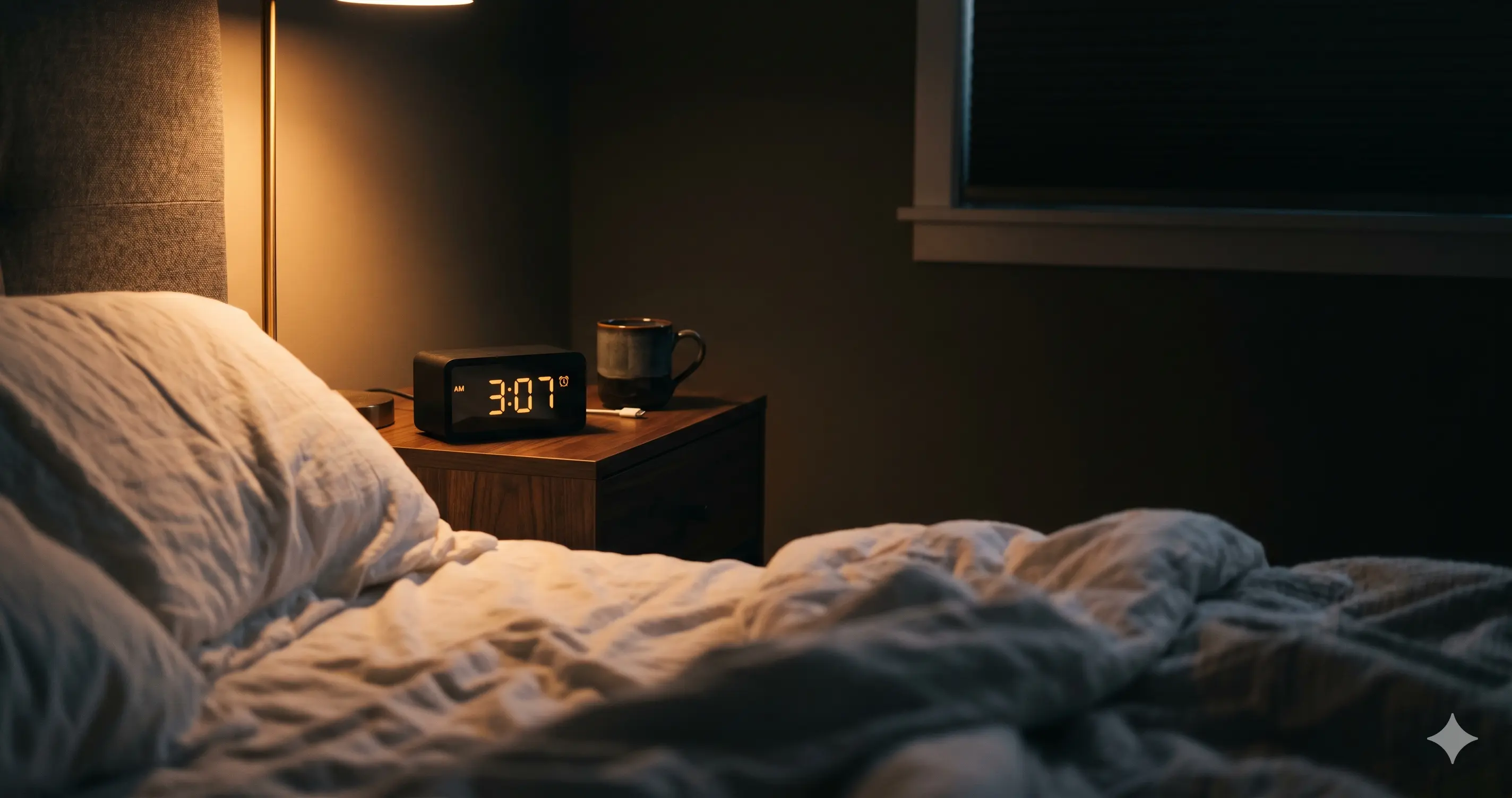
You did everything right yesterday. Ate well. Exercised. Didn't drink caffeine after 2pm. But at 3:07am your eyes snapped open, your mind started racing, and you lay there staring at the ceiling for two hours — exhausted but wired. This is not a willpower problem. It's a cortisol problem. And once you understand the biology driving it, fixing it becomes dramatically more straightforward.[1]
- Cortisol follows a strict daily rhythm — chronic stress breaks that rhythm in ways that directly cause insomnia.
- Waking between 2am and 4am is a recognized cortisol pattern, not a random sleep disorder.
- The stress-sleep cycle is self-reinforcing: poor sleep raises cortisol, which makes sleep worse.
- Breaking the cycle requires addressing both the stress physiology and sleep behavior simultaneously.
- Morgan Adams, YouthEffect's BBT-I certified Sleep Coach, specializes in exactly this pattern.
Cortisol is often called "the stress hormone," but that misses most of what it actually does. Cortisol is your primary wake signal. Under normal conditions, it rises sharply in the morning — peaking about 30 to 45 minutes after you wake up — then gradually declines throughout the day, reaching its lowest point around midnight to let sleep happen.
This is your cortisol awakening response (CAR), and it's one of the most important rhythms your body runs. When it works correctly, you wake up energized, power through your day, and fall asleep naturally as cortisol bottoms out at night.[1]
When you're chronically stressed, the rhythm breaks. Sustained psychological stress keeps cortisol elevated throughout the day. That elevated baseline doesn't drop cleanly at night — it stays too high when you're trying to fall asleep, making you feel "wired but tired." And then, in the early morning hours, cortisol starts its next ascent before your sleep cycle has completed.[2]

"Most of my clients arrive thinking they have a sleep disorder. What they actually have is a dysregulated cortisol rhythm. The sleep is the symptom. The stress physiology is the root."
Morgan Adams — Certified Sleep & Recovery Coach, BBT-I Practitioner, Certified Health Coach (IIN). Learn more about sleep coaching at YouthEffect →
Why Waking Up at 3am Is Often a Cortisol Problem, Not a Sleep Disorder
The 2–4am awakening is one of the most common sleep complaints — and one of the most misunderstood. Most people assume they have insomnia. Many are prescribed sleep medications that address the symptom without touching the cause.
Here's what's actually happening biologically. During healthy sleep, cortisol levels are at their lowest from roughly 11pm to 2am. Starting around 3am, the body begins its pre-dawn cortisol surge in preparation for waking. Under normal conditions, this surge is gradual and doesn't disturb sleep. Under chronic stress, that surge is amplified — strong enough to trigger full wakefulness.[2]
This is why CBT-I (Cognitive Behavioral Therapy for Insomnia) — the approach Morgan Adams is certified to deliver — consistently outperforms sleep medication in long-term outcomes. CBT-I addresses the arousal system, not just the sleep symptom. Combined with cortisol regulation strategies, results are faster and more durable.
If the 3am waking pattern sounds familiar, take our Why Am I Always Tired quiz to assess your full sleep pillar — or go straight to the sleep quiz result page to see your personalised next steps.
Think your sleep problem might actually be a cortisol problem?
Take the Sleep Assessment →
How Stress Physically Prevents Deep Sleep Stages
Sleep isn't one continuous state. It cycles through four stages roughly every 90 minutes, with the most restorative work — tissue repair, memory consolidation, hormone regulation, immune function — happening in stages 3 and 4, the deep slow-wave sleep phases.
Elevated cortisol suppresses these deep stages. The stressed nervous system stays in a state of biological vigilance — sympathetic activation — that is physiologically incompatible with the parasympathetic state required for deep sleep to occur.[4]
The consequences are cumulative. Each night of cortisol-disrupted sleep:
- Reduces the next day's stress resilience — raising cortisol baseline further
- Impairs glucose regulation — worsening metabolic health
- Decreases growth hormone secretion — slowing tissue repair and muscle recovery
- Elevates inflammatory markers — accelerating biological ageing
- Reduces executive function — making stress management harder the next day
This is why the stress-sleep cycle is so damaging. Poor sleep generates the exact physiological conditions that make stress worse — and worse stress degrades sleep further. Breaking out of it requires addressing both simultaneously. If you're also struggling with weight despite trying everything, this cycle is often the missing piece — see our weight loss coaching page for how these pillars connect.
→ Related: The 5 Pillars of Youthspan — how sleep, stress, and nutrition form one connected system
→ Related: How Chronic Stress Ages You Faster: The Cortisol-Telomere Connection
6 Evidence-Based Ways to Break the Stress-Sleep Cycle
Morgan Adams works with her clients on a tiered protocol that addresses the cortisol rhythm first, then the sleep behavior. Here is the framework:
Cortisol rhythm is trained by consistent wake times. If you sleep until 9am after a bad night, you push the entire cortisol curve later — making that night's sleep harder. Set a consistent wake time and hold it regardless of how you slept. This is the single most powerful circadian anchor available.
Ten to fifteen minutes of outdoor light (no sunglasses) within the first half hour of waking stabilizes the day's cortisol curve and improves that night's sleep architecture.[5] If outdoor light isn't available, a 10,000-lux light therapy box achieves the same effect.
The stressed nervous system doesn't transition to evening automatically — it needs a signal. A consistent "evening anchor" (10-minute walk, breathwork, or tea ritual) trains the cortisol system to begin its descent. Consistency matters more than the specific activity.
Scheduled worry time — a 15-minute daily window to write down concerns and possible next steps — reduces nighttime intrusive thoughts by giving the brain a designated processing window that isn't 3am.[4]
When blood sugar drops in the early morning hours, the body releases cortisol to raise it — triggering the 2–4am awakening even when psychological stress is low. A small protein-containing snack before bed (plain Greek yogurt, a handful of almonds) can stabilize blood sugar through the night.
Recovery is when cortisol drops. Productivity is what becomes possible after recovery. Building deliberate recovery into every day — not just as a reward — retrains the cortisol rhythm over time. This is a core principle of how Morgan coaches at YouthEffect's sleep program.
What Happens to Your Body When You Finally Fix Both
When the stress-sleep cycle is broken — when cortisol rhythms normalize and sleep architecture deepens — the effects cascade through every other pillar of your Youthspan.
Metabolic health improves as blood sugar regulation stabilizes. Inflammatory markers fall. Exercise performance and recovery accelerate. Emotional resilience rebuilds. The cognitive fog lifts. Many of Morgan's clients report changes they had been trying to achieve for years through diet and exercise alone — because without this foundation, the other pillars never had stable ground to build on.
"Sleep is the one pillar where improvement is almost immediately felt. Clients who couldn't lose weight despite eating well often start losing weight once sleep normalizes. The foundation changes everything."
— Morgan Adams, Certified Sleep & Recovery Coach, YouthEffect™
Better sleep → lower cortisol → stable blood sugar → easier weight management → more energy for exercise → faster recovery → better emotional resilience → deeper sleep the next night.
Ready to break the cycle? See how the 5-Pillar Youthspan Framework addresses all five interconnected systems — not just sleep in isolation. You can also read real results on the client transformations page or visit the science page for the research behind everything covered here.
→ Related: How to Build a Morning Routine That Extends Your Youthspan
Frequently Asked Questions
Why do I wake up at 3am every night?
The most common cause of consistent 3am awakening is a dysregulated cortisol rhythm. The pre-dawn cortisol surge — which normally begins gently around 3–4am in preparation for waking — is amplified under chronic stress conditions, becoming strong enough to trigger full wakefulness. The fix involves both cortisol regulation (consistent wake times, morning light, stress management) and sleep behavior strategies (CBT-I techniques). Take our Why Am I Always Tired quiz to assess your specific pattern.
Does stress really cause insomnia?
Yes, directly. Elevated cortisol from chronic stress suppresses the deep sleep stages (slow-wave sleep), delays sleep onset by keeping the nervous system in physiological alertness, and causes early-morning wakefulness through the amplified pre-dawn cortisol surge. The stress-insomnia connection is one of the most well-documented in sleep science. See our Why Am I Always Stressed quiz if stress is your primary concern.
Is melatonin the answer for stress-related insomnia?
Melatonin supplements can help with sleep onset timing (circadian phase shifting) but do not address the underlying cortisol dysregulation that drives most stress-related insomnia. For the 3am awakening pattern specifically, melatonin taken at sleep onset typically wears off before the early-morning cortisol surge occurs. Cortisol regulation strategies and CBT-I techniques address the actual mechanism. Morgan Adams is a BBT-I Practitioner and can help you find the right approach — visit the sleep coaching page to learn more.
How long does it take to fix sleep once I address stress?
Morgan Adams' clients typically see meaningful sleep improvement within 2–4 weeks of implementing consistent circadian anchors (fixed wake time and morning light) alongside one or two stress regulation practices. Full normalization of sleep architecture — the deep restorative stages — generally takes 4–8 weeks of consistent implementation. Results vary based on the severity of cortisol dysregulation and other pillar factors. Book a free discovery call to discuss your specific situation.
Can I fix sleep without addressing stress?
Sleep hygiene alone (cool room, dark environment, screen limits) addresses the conditions for sleep but not the cortisol system actively disrupting it. For chronic stress-related insomnia, addressing the cortisol rhythm is necessary. Sleep hygiene is the floor, not the ceiling. This is why the 5-Pillar Youthspan Framework addresses both sleep and stress as interconnected pillars rather than isolated problems.
References
- Kelly Murray Sleep Coaching. 5 Things You Can Do for Better Sleep in 2026. February 2026. kellymurrayadultsleep.com
- Kelly Murray Sleep Coaching. Cortisol and insomnia mechanisms. kellymurrayadultsleep.com
- Journal of Clinical Sleep Medicine. Heightened physiological arousal in insomnia — cited in Kelly Murray Sleep Coaching (2026). kellymurrayadultsleep.com
- Kelly Murray Sleep Coaching. Cognitive arousal and CBT-I techniques. kellymurrayadultsleep.com
- Kelly Murray Sleep Coaching. Morning light and circadian rhythm regulation. kellymurrayadultsleep.com
Conclusion: The Cycle Is Real — and It's Breakable
The sleep-cortisol cycle is a biological reality, not a character flaw. You're not failing at sleep because you lack willpower — you're caught in a self-reinforcing physiological loop that requires a two-sided intervention: the cortisol system and the sleep behavior, addressed together.
Understanding the mechanism is the first step. Getting the right coaching to fix it is the second. YouthEffect's sleep coaching program, led by BBT-I Practitioner Morgan Adams, is built specifically for this pattern. And the 5-Pillar Youthspan Framework ensures that as your sleep improves, every other pillar benefits alongside it.
Your Priority Pillar might be sleep. It might be stress. The fastest way to know is to take the quiz.
Find Your Priority Pillar
Take the 2-minute Youthspan Quiz — find out whether sleep or stress is your most urgent starting point.
Take the Youthspan Quiz →Science-based. Coach-guided. Results that last.
Wellness Disclaimer: The content on this page is for informational and educational purposes only. YouthEffect™ provides health and wellness coaching, not medical advice, diagnosis, or treatment. Always consult a qualified healthcare professional before making significant changes to your sleep routine or wellness program, especially if you have existing health conditions. Individual results may vary.